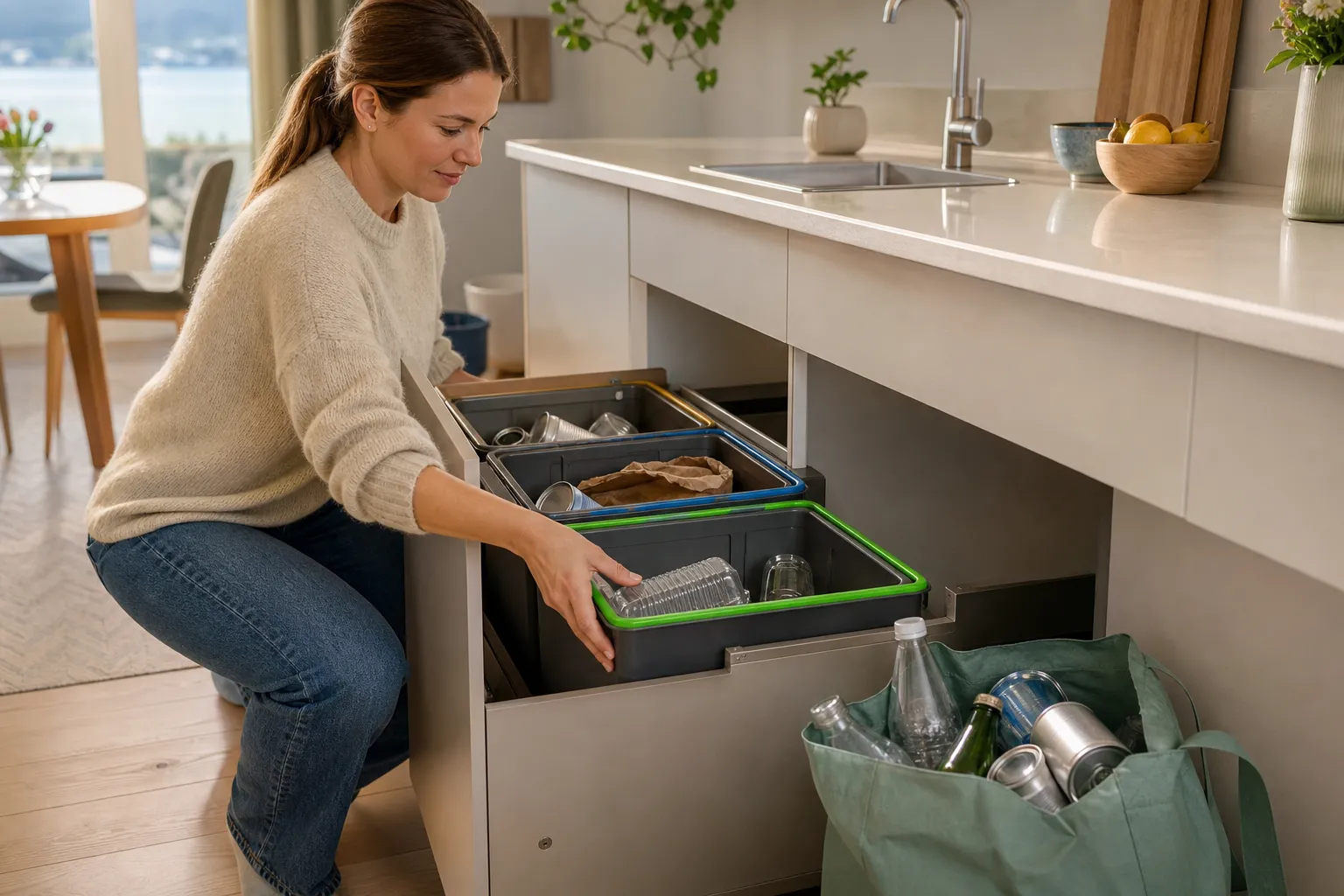
Norway has common sorting labels and national rules, but not one identical household bin system. A colour or bag used in Oslo may mean something different elsewhere. The correct first source is the municipality, building manager or waste company responsible for the address.
One system is much more uniform: pant, the deposit refunded when eligible beverage bottles and cans are returned.
Sources: Sortere — the national sorting guide; Sortere — official sorting labels; Infinitum — what can be returned for deposit; City of Oslo — recycling in Oslo.
Find the local system for your address
Most homes separate several familiar fractions: food waste, plastic packaging, paper and cardboard, glass and metal packaging, and residual waste. The container, bag colour, collection day and whether glass and metal are collected at home all vary.
Search the municipality’s waste page with your address. In an apartment building, also read the signs in the waste room. If the systems conflict, ask the building manager rather than guessing.
Sortere.no lets you search for an item and see how it should be handled. The national sorting labels can help connect Norwegian words with the correct fraction.
Packaging is not the same as the material itself
Collection streams often say plastemballasje or glass og metallemballasje: plastic packaging, or glass and metal packaging. A plastic toy, drinking glass, frying pan or mirror may be made from a named material but still belong somewhere else.
Empty packaging and remove obvious residue. Local guidance decides how clean it must be and whether lids should be separated.
Pant goes back through shops
Look for the deposit symbol on Norwegian beverage cans and plastic bottles. Eligible containers can normally be returned to a reverse vending machine in a grocery store.
The current refund is NOK 2 for containers up to and including 0.5 litres and NOK 3 for larger eligible containers. The container should be empty and the barcode readable. Glass bottles, food cans, milk cartons and containers without the deposit symbol do not receive the refund through this system.
The machine issues a receipt that can be used in the store or paid out according to the store’s arrangement. Do not crush the container before returning it because the machine needs to identify it.
Electronics and hazardous waste need another route
Batteries, light bulbs, electrical products, paint, chemicals and other hazardous waste should not be hidden in residual waste. Municipal recycling stations accept defined categories. Retailers also have take back duties for types of electrical products they sell, even when the item was bought elsewhere.
Large furniture and renovation waste normally go to a recycling station or reuse service, not beside the communal bins. Leaving it there can create costs for the building and does not turn it into reusable material.
Oslo is an example, not the national template
Oslo currently uses purple bags for plastic packaging, green bags for food waste and ordinary bags for residual waste, placed in the same outside container for optical sorting. Paper has a separate container, while glass and metal packaging go to local collection points.
That description is useful only if you live in Oslo. The national habit to learn is not a colour. It is checking the address specific system, using the correct fraction and keeping special waste out of household bins.
For other practical home arrangements, the electricity guide explains the two company system that often surprises newcomers.